

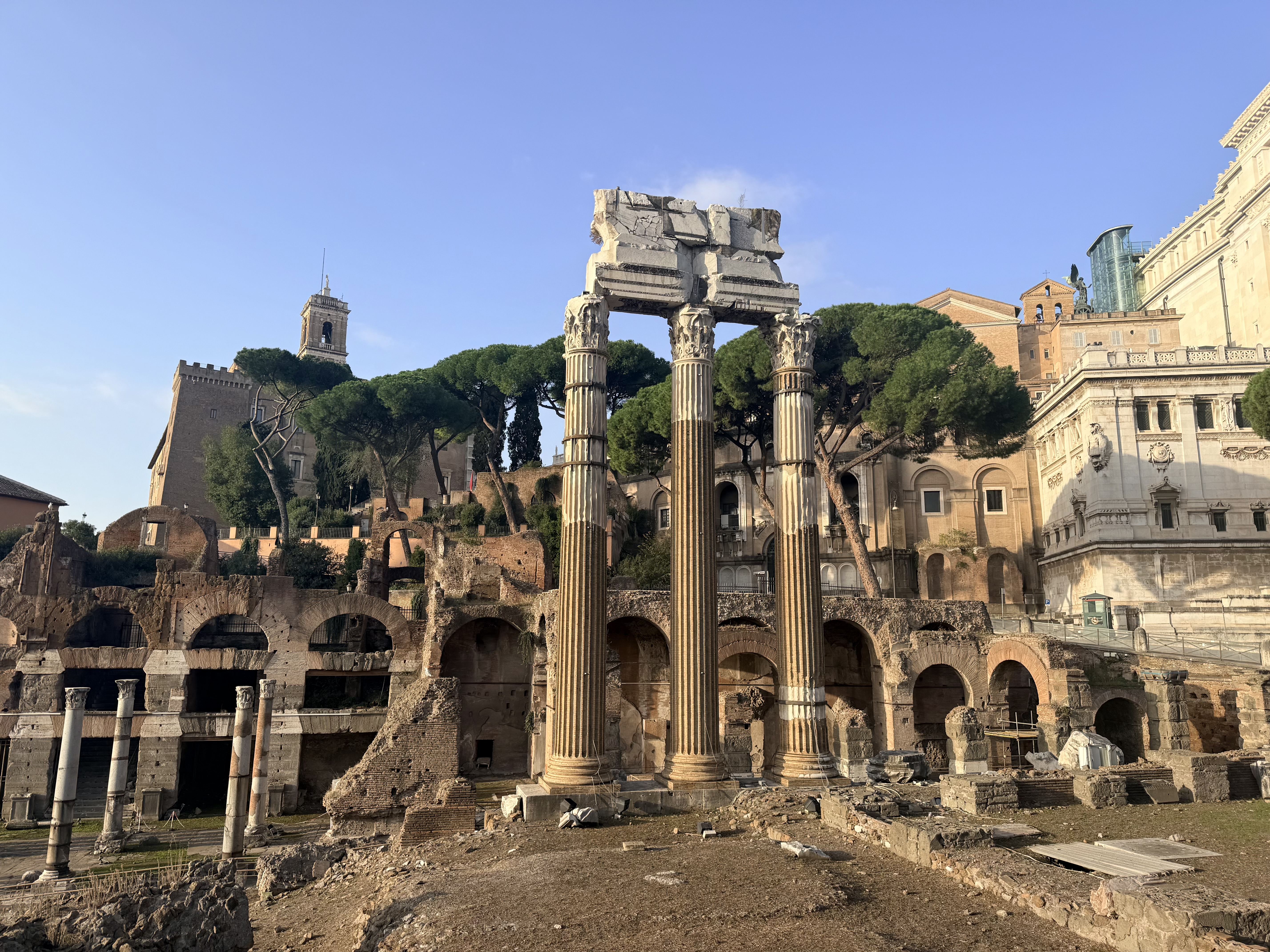
Walking through ancient Italian streets felt like wandering through the layers of human consciousness. A sort of lasagna. Italy is famously charming and romantic—the food, the sounds, the warm bustling of people out and about—but it also has an irresistible philosophical pull.
Every corner reminded me of the people who lived, loved, ruled, resisted, and died there. And I learned so much more than I expected.
1. Time Hits Differently in Rome
It has to. I kept thinking this while walking past the site where Julius Caesar was assassinated, where Marcus Aurelius spoke the truth, and the area where St. Peter was crucified. I don’t know about you, but I can’t simply stroll by 2,000 years of some of the world’s most consequential actions and not feel it rearrange something inside me.
Rome especially forced me to reckon with time not just as a linear or straight line. It’s more of an all-encompassing presence. Something we all stand inside of, not behind or ahead of it.
American history is so young. World history is more detailed and broader. But ancient history? That’s deep and vast. And Rome made me realize how history rhymes, contradicts itself, and repeats in ways we still haven’t fully grasped.
2. Or Does It?
Because then I looked around and saw statues honoring anti-fascist heroes who gave their lives resisting tyranny. Historically speaking, that JUST happened. And yet, Italy continues to elect a leader who is, quite honestly, fascist-adjacent.
How can a culture be steeped in reminders about the perils of authoritarianism and still flirt with its return?
Roman Stoics and Italian resisters left behind a handbook on ethics for future generations to learn from and follow. If Italians, with their ruins, their monuments, their visible warnings, can’t resist repeating history, what chance do the rest of us have?

Recent Comments